

Losing a tooth can leave you with more than an empty space in your smile. Missing teeth can affect how you chew, speak, and feel about your appearance. Fortunately, there are several ways to replace missing teeth, and dental implants are one of the most versatile options available today.
But are implants right for everyone?
Not necessarily. Dental implants can be an excellent solution in many situations, while a bridge or denture may make more sense for someone else. At Conyers Family Dentist, we can evaluate your smile, discuss your goals, and help you understand which tooth replacement option best fits your needs.
What Are Dental Implants?
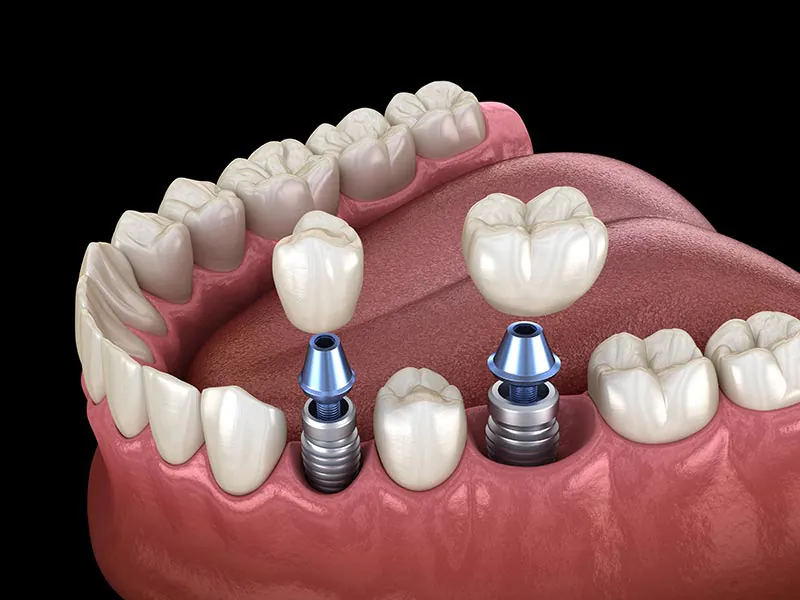 A dental implant is a small titanium post that is surgically placed into the jawbone to replace the root of a missing tooth. After the implant has healed and integrated with the surrounding bone, it can support a dental restoration such as a crown.
The result is a replacement tooth that is designed to look and function much like a natural tooth.
Dental implants can be used to replace:
- A single missing tooth
- Several missing teeth
- An entire arch of missing teeth when used to support an implant-retained denture or other full-arch restoration
One of the biggest differences between implants and some other tooth replacement options is that implants replace the root of the tooth as well as the visible portion.
When Should You Consider a Dental Implant?
There are several situations where implants may be worth considering.
You're Missing a Single Tooth
If you've lost one tooth, a dental implant with a crown can replace it without requiring the neighboring teeth to support the restoration.
A traditional dental bridge, on the other hand, uses adjacent teeth to support the replacement tooth.
For patients who want an independent replacement that feels and functions more like a natural tooth, an implant may be an appealing option.
You're Missing Several Teeth
Implants aren't limited to replacing individual teeth. If you're missing multiple teeth, implants can also be used to support a bridge or other restoration.
This can provide a more stable alternative to a traditional removable partial denture in some situations.
You Want a More Permanent Tooth Replacement
One reason patients choose implants is that they're designed to be a long-term tooth replacement solution. Unlike removable dentures, the implant itself is fixed in the jaw.
Of course, implants still require regular dental care and good oral hygiene, and the restoration attached to the implant may eventually need maintenance or replacement.
You Want to Help Preserve the Jawbone
When a natural tooth is lost, the bone that once supported its root no longer receives the same stimulation. Over time, the bone in that area can gradually shrink.
Because a dental implant is placed into the jawbone, it can provide stimulation similar to a natural tooth root and may help maintain bone in the area.
This is one of the unique advantages of implants compared with tooth replacement options that only replace the visible portion of the tooth.
When Might Another Option Be Better?
Dental implants can be a great choice, but they're not automatically the best solution for every patient.
A Dental Bridge May Make More Sense
A traditional bridge may be a good option if you want to replace a missing tooth without undergoing implant surgery.
Bridges can also be completed relatively quickly and may be appropriate for patients who aren't good candidates for implants or who prefer a different treatment approach.
Your dentist can evaluate the health and structure of the teeth surrounding the missing tooth to determine whether a bridge is a good option.
A Partial Denture May Be a Better Fit
If you're missing several teeth, a removable partial denture may provide a practical way to replace them.
Partials can replace multiple teeth without requiring an implant for every missing tooth. They may also be a more affordable option for some patients.
For patients who aren't ready for implant treatment—or who aren't candidates for implants—a partial denture can still restore important aspects of their smile and chewing function.
Full Dentures May Be the Right Choice
If you've lost all or most of the teeth in an upper or lower arch, a traditional full denture may be appropriate.
Implants can sometimes be used to improve the stability of a denture, but implant treatment isn't always necessary or appropriate. A conventional denture may be a better fit depending on your oral health, preferences, budget, and treatment goals.
What Makes Someone a Good Candidate for Dental Implants?
A dental implant consultation is about more than simply looking at the missing tooth. Your dentist will consider several factors, including:
- The health of your gums
- The amount and quality of bone available to support an implant
- The location of the missing tooth
- Your overall oral health
- Your ability to maintain good oral hygiene
- Your medical history and individual circumstances
- Your goals and expectations for treatment
If you've experienced bone loss in the area of a missing tooth, you may still be able to receive an implant, but additional treatment may sometimes be recommended first.
Your dentist can determine whether you're a candidate and explain what your treatment would involve.
Don't Wait Too Long to Replace a Missing Tooth
You don't necessarily have to replace a tooth immediately after losing it, but it's a good idea to discuss your options with your dentist sooner rather than later.
The longer a tooth is missing, the more changes can occur in the surrounding teeth and jawbone. Nearby teeth may shift, and bone loss can make future implant treatment more complicated in some cases.
Getting an evaluation early gives you more information about your options and allows you and your dentist to create a plan based on your needs.
Which Tooth Replacement Option Is Right for You?
There isn't one solution that works for every missing tooth or every patient.
Dental implants may be ideal if you're looking for a stable, long-term replacement and want to replace the root of the missing tooth. Dental bridges can offer a fixed replacement without implant surgery, while partial or full dentures can be practical options for replacing multiple or all missing teeth.
The right choice depends on your oral health, the number and location of your missing teeth, your preferences, and your long-term goals.
At Conyers Family Dentist, we're here to help you understand those choices without making the decision more complicated than it needs to be. We'll evaluate your smile, answer your questions, and help you determine whether dental implants or another tooth replacement option is right for you.
If you're living with missing teeth, contact Conyers Family Dentist to schedule a consultation and explore your options for restoring your smile.
